
01 · Switching
Selecting a grip
Some users find grip switching through muscle contractions difficult. Deterica uses two buttons to select the grip.
Why another approach
A myoelectric hand uses electrodes to read muscle signals. Deterica explores another input: rotation of the residual limb, measured by a position sensor.
01 · Switching
Some users find grip switching through muscle contractions difficult. Deterica uses two buttons to select the grip.
02 · The input
Electrode signals can change with conditions such as sweat and socket movement. Deterica measures an angle. Its mechanical fit and everyday reliability still need testing.
03 · Learning
Deterica does not require an EMG signal as its input. Users still need to learn its movement range and buttons. We have not established whether this takes less effort.
A 2019 study described control difficulties reported by users and therapists. Their experiences do not establish that every EMG system is difficult to use. Read the study.
Deterica offers a different control input. We have not yet shown that it is easier, less tiring, or more reliable than EMG in everyday use. Comfort, weight, and socket fit also matter, and require their own testing.
The control
The residual limb already moves. The method uses that movement directly, as a position, and not as a signal that must be classified.
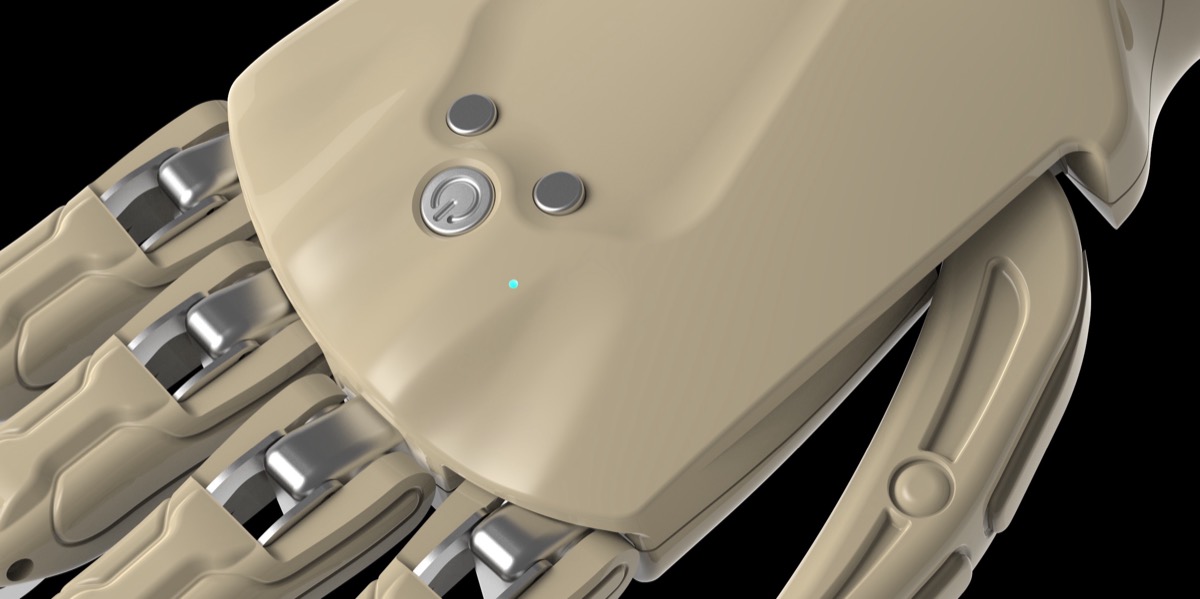
The calibration is two button holds on the hand. It needs no clinic visit, no laptop, and no software that only a specialist can run. A user who changes their mind holds the button again.
The shell, the finger pads, and the buttons are each specified on their own. The hand can be matched to a skin tone, or made to stand out on purpose.
The hand runs on its own battery. An ordinary USB power bank tops that battery up, and the user keeps the hand on while it charges.
It needs a preserved rotation of the residual limb. That is the eligibility criterion, and it is the first question to put to a prosthetist.
The user holds one button for 2 seconds at the position that means "fully open".
The user holds the other button for 2 seconds at the position that means "fully closed".
The two saved points become the whole range. The kit clamps anything outside them.
A short press steps forward or back through six grips. Nothing waits for a gate.
Video
A control method is easy to describe and hard to believe. So here is the hand, doing the thing this page says it does.